Voice Search Optimization Strategies keeps growing as more people talk to their phones or smart speakers. Many voice search users want quick help, and they usually ask full questions instead of short terms. When you think about how voice search queries shape what we read online, it feels clear that writers must pay attention. Voice search SEO pushes us to write naturally, and search engines reward sites that do this well.
Voice search results also reflect how people really speak. If we use simple ideas and steady search optimization, we can reach more readers. A website for voice search works best when it sounds like a real person. These voice search queries tend to feel casual yet focused, and that is what makes them special.
What is Voice Search Optimization?
Voice search optimization efforts help your site appear when someone speaks into a phone or smart speaker. Many voice searches happen every single day, and people want answers that make sense right away. With voice search, people expect clear replies, even if the question is long. Voice search SEO plays a big role because search engines try to match how people talk.
Voice search results often pick answers that feel natural. When you apply strong search optimization, your site becomes easier to find. A website for voice search should reflect how real conversations sound. These voice search queries tend to flow like everyday speech, and that is why they matter to content creators.
Top 4 Metrics to Track Voice Search Optimization Strategies
Tracking your voice search work can feel confusing at first, but it gets easier. Voice search users speak freely, which leads to different patterns. A website for voice search benefits from steady voice search SEO growth. Many voice searches sound simple but carry real meaning. Search engines use these signs to find the best match for you.
Voice search results often depend on small details. Search optimization is more than guessing keywords. With careful checks, you can see how voice search queries tend to affect behaviour. For businesses in specific regions, like those offering SEO Gloucestershire services, voice search can help connect with local audiences effectively.
1. Conversion rate
Conversion rate tells you how many visitors take action after landing on your site. Many voice searches come from people who want answers fast, so a clear page matters. Voice search users look for simple steps, and search engines reward helpful pages this way. Voice search results show your site when your message is clean and direct. Search optimization helps you guide your visitors to the right choice.
When voice search queries tend to match your page, your rate improves. The website for voice search must support actions that work smoothly on mobile devices, since people often speak on the go.
2. Engagement
Engagement measures how long people stay on your site or how much they explore. Voice search queries tend to bring curious readers who want more. Many voice searches start with a question that needs a deeper reply. Voice search SEO boosts your presence by answering questions clearly, and search engines notice when your page holds attention. Voice search optimization helps keep the tone friendly and steady.
Thus, a website for voice search must reflect natural conversation to keep readers involved. Voice search results can improve when users stay and learn. Businesses offering local SEO services UK can use voice search to better connect with regional audiences.
3. Intent
Intent shows why someone asks a question in the first place. Many voice searches carry a clear purpose. Voice search users might want directions, facts, or steps. Search engines use intent to match pages with real answers. Voice search SEO also supports this by shaping content in a friendly style.
Voice search optimization helps writers think as speakers do, and voice search results respond best to direct meaning. A website for voice search should show that it understands what people hope to find, as voice search queries tend to reveal strong clues about the user’s goal.
4. User fallout
User fallout tracks where people leave your site. Many voice searches move fast, so visitors will exit if they cannot find what they need. Voice search users expect quick clarity. Voice search SEO reduces dropout by guiding readers this way. Search engines rank pages that stay steady and clear, so voice search results favour content that keeps people from leaving too soon.
Voice search queries tend to show intent, but your page must still help. A website for voice search must keep the message simple. Voice search optimization helps smooth the journey. For expert advice, SEO consultants London can help businesses refine their voice search strategies to improve performance.
How to Optimize for Voice Search SEO Content?
Natural language processing plays a strong part in shaping how people find answers online. Search engines want pages that sound like real talk. Google Assistant and other voice assistants listen for simple meaning.
Smart devices often choose a direct answer. Search engine algorithms connect voice queries to your page, so make sure you follow this structure. With voice search technology growing, writers must focus on user intent so that voice search helps people find results quickly. Let’s explore how to create content for voice search with care.
- Choosing a topic: Picking a topic for voice search starts with asking what users want. Many people speak to mobile devices when they need something quickly. Local SEO strategies play a part when people look for nearby help, and long tail keywords support these questions. Local voice search queries guide business owners mostly, but local searches rise when people want real direction, so it’s starting to apply to all kinds of audiences. All in all, local conversational keywords help bring traffic. Today, common voice search queries reflect daily needs. Local business owners benefit from a Google Business Profile for a stronger reach, though.
- Structuring answers: When you structure answers, keep the tone simple. Search engine visibility grows when readers understand your message. Search engine rankings improve with clear steps. Search engine results pages often select short, structured data, so direct answers help you reach the top more easily. Featured snippets sometimes appear from calm and steady writing as well, and local listings appear when your message is clear. Google Maps can show your page when you guide readers well, making your answers even more optimized. Using Google Knowledge Graph can connect your answers to bigger topics and a wider reach to your answers.
- Optimizing long-form content: Long-form content stays important. Voice assistant users still read when they want details, so digital marketing also relies on thorough pieces. Google Assistant looks for pages with meaning, but search engine results boost pages that feel helpful, so keep this in mind. Local queries bring people to your service more easily this way, allowing local voice searches to guide real customers to your page. Applying technical SEO supports these pages, and schema markup helps computers understand your words better. With mobile optimization, you can also keep your pages smoother and mobile-friendly as pages load with ease.
Advantages of Using Voice Search
Voice search presents a chance to reach more people since smart devices help families find answers without typing, giving more convenience and reach. Luckily, voice search capabilities grow each year. For instance, digital marketing strategies have now improved to the point that they can listen to speech patterns more effectively.
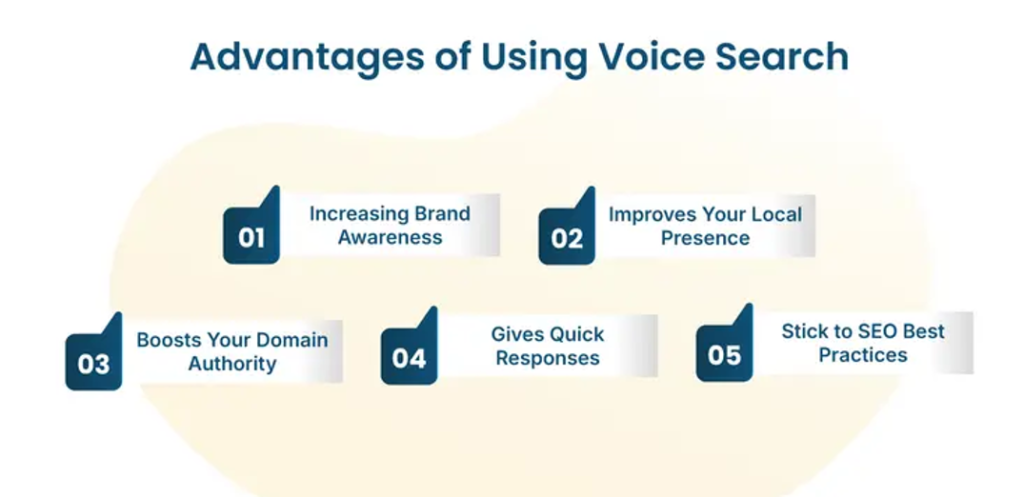
Page speed matters more than ever because readers expect quick results. However, search engine optimization still plays a central part. It’s important that both work hand in hand. Let’s look at a few big advantages and why they matter.
Increasing Brand Awareness
Voice search capabilities help people learn your name without any extra work, as smart devices read your answers out loud. Today, many families use voice assistants even more, so digital marketing can be applied when people hear your brand often. And with search engine optimization, you can take a spot on results pages more easily.
These results come up better when you offer simple answers, and voice search technology can help you with that by offering smooth replies. When a reader hears your name in a helpful answer, they remember it.
Improves Your Local Presence
Local voice searches help business owners stay connected to nearby customers. Local search results appear when people ask their phones for help, and when you pair this with digital marketing, it strengthens local reach even more. Voice search capabilities also help people discover small shops since smart speakers tell users where to go.
All in all, search engine optimisation boosts your visibility because search results highlight close providers, and voice search technology supports real community growth.
Boosts Your Domain Authority
Domain authority rises when people trust your answers. Voice search technology reads clean wording with ease. Search engine optimization supports that effort. Search results reflect simple messages because natural language helps visitors understand the topic better. Smart devices read strong replies as well, so your digital marketing should keep this in mind to build more impact. Natural language processing also supports clear points. When your words match user needs, search engines notice.
Gives Quick Responses
Search results reward fast answers that feel natural. Voice search technology handles spoken words smoothly. Digital marketing strategy relies on speed. Search engine optimization lifts pages that respond right away. Smart devices return answers in seconds. Natural language carries meaning clearly. Many people ask short questions. User intent becomes easier to understand. When your page offers a direct reply, readers trust you more.
Stick to SEO Best Practices
Keeping best practices in place helps your site stay ready for visitors. SEO strategy keeps your work steady this way. Know that voice queries often prefer simple replies, and voice search rankings rise when your content flows well. Voice search trends show that readers want clarity. Hence, voice search performance depends on user trust.
Traditional SEO still matters, and traditional search still helps you grow, but voice search can add to that as long as you mind your quality. That’s why you should create content that’s not only optimized for SEO but is also friendly and natural. Let’s look at these points one by one.
- Work keywords into your content naturally: Keywords work best when they feel like part of the story. Using conversational language helps readers understand your ideas better. You can use voice search keywords to blend into these simple phrases. Create content that feels like someone talking to a friend through keyword research to maximize it.
- Make mobile your priority: Mobile devices handle most voice queries, so mobile-friendly pages help people read with more ease and convenience. Keep in mind that page speed keeps visitors from leaving as well. When a page loads fast, people trust it. Today, many readers explore pages on phones; hence, a good layout makes their journey easier.
- Boost your site’s speed: Fast-loading pages keep readers focused. Page speed helps search engines understand your value. When pages drag, people leave. Using strong hosting helps. Clean code also reduces problems. Faster sites feel more modern and comfortable, which users prefer nowadays.
- Use FAQs to inspire content: Frequently asked questions show what people want. FAQs form patterns that guide your writing. Writers can predict how readers think, thus creating the FAQs page. Using common questions also reveals intent. This helps create stronger, clearer answers.
- Add schema markup for clarity: Schema markup helps search engines understand your content. Search engine algorithms read these signals. Schema markup adds context. It shows what your page is about. This helps voice assistants pick your answer, which provides a clear structure that ultimately improves trust.
Differences Between Voice Search vs. Typed Search
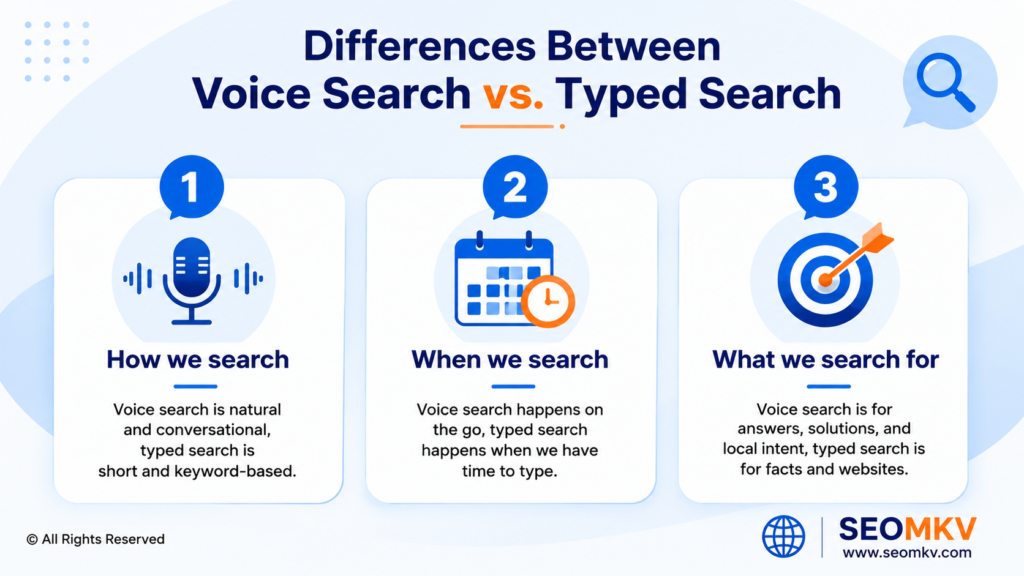
Voice search and typed search feel different even though both lead to answers. Voice search encourages speakers to talk casually, while traditional search prefers short words typed. While both work differently, both matter.
- How we search: People type short terms. Voice search users speak full questions. Smart devices listen for a tone. Natural language guides the answer. Typed search relies on speed. Voice search feels more relaxed. User intent stays important in both approaches.
- When we search: People speak on the go. Smart devices sit in kitchens or cars. A typed search usually happens when someone has more time. Voice search offers fast responses. Families use voice search during busy days. Timing shapes the question and how people search for answers.
- What we search for: Typed search often looks for deeper topics. Voice search questions usually seek quick facts. Smart speakers answer simple queries. Natural language guides the reply. People ask about the weather, directions, and small tasks. But both methods try to solve problems.
Make Your Website Voice-Search Friendly with Better User Experience
A strong user experience makes your site feel more welcoming from the moment visitors arrive. Smart devices read pages that feel complete and well-structured, so each part should guide readers smoothly. Voice search helps new readers find your work, but they stay only when everything feels clear. Natural language processing supports this by connecting your meaning to user needs in a simple way.
Search engine algorithms also highlight pages that organize ideas with care. When your site loads quickly and stays simple, people return more often. Voice assistant users trust ease, and better design supports your digital marketing by keeping attention steady. It all starts with clarity and thoughtful layout.
A second part of improving the experience comes from understanding how real people move through a page. Some readers skim, while others want details, so your design should support both habits. Short sections, clean spacing, and readable text make the journey smoother. Helpful links guide readers to deeper content without confusion.
Strong mobile structure matters even more because many people use voice tools on the go. When your site feels steady and comfortable on any screen, visitors relax and keep exploring. This steady experience makes voice search even more effective.
Read more about what is a 404 error code
FAQs
Is voice search the core functionality of Alexa and Siri?
Alexa and Siri were built with voice control at the center of their design, so voice search is a major part of what they do each day. These systems listen for natural language and try to match spoken questions with helpful answers.
They use advanced tools to understand accents, simple speech, and tone. Both systems support daily tasks like reminders, directions, and facts. Because of this, many people rely on them to find quick and clear information.
How do I optimize my website for voice search users?
To optimize your website for voice search users, keep your writing simple and natural. These visitors speak in full questions, so your content should match that tone. Use clear phrases and provide direct answers near the top of your page.
Mobile-friendly design helps because many people speak into their phones. Local information also matters when readers look for nearby help. Strong structure and fast loading times improve the experience. Finally, stay focused on what people ask most often.
What role does Google Assistant play in voice search queries?
Google Assistant acts like a bridge between the spoken question and the right digital answer. When someone speaks a question, Google Assistant listens for natural language clues and matches those clues with online content.
It uses advanced tools to understand intent, location, and topic. It also pulls facts from trusted pages. For many families, Google Assistant becomes a daily helper for directions, reminders, and simple tasks. By doing this, it shapes how people search online.
What is the significance of long-tail keywords in voice search?
Long tail keywords matter because they match how people speak. Voice search often uses longer questions with simple language. These keywords help search engines find pages that answer these questions clearly.
When your content includes these phrases naturally, your page becomes easier to match with real needs. It also helps you stand out from shorter and more crowded terms. This keeps your writing relatable and easy for readers to follow.
What role do featured snippets play in voice search results?
Featured snippets serve as quick answers that search engines pull to the top of the page. Voice assistants often read these snippets out loud because they offer direct and simple replies. When your content wins a snippet, your work becomes more visible.
These snippets help people get information fast, which is important in voice search. They also build trust because readers hear your answer first. This makes them a valuable goal for any content creator.