Every day, tons of content gets posted online. So, how do you make sure your audience finds you? At SEOMKV, SEO, we know the answer: focus on the right search terms.
These keywords help people discover your business or creations. By using them, we can boost your online presence, bring more visitors to your site, and help you connect with your audience. That’s how we cut through the noise and make sure your message gets seen.
What are Search Terms?
{searchterms} are the words or phrases users enter into search engines when looking for information, products, or services online. Think of the last thing you typed into the search box on Google—that was a search term.
These terms connect users with the information on the internet, helping search engines deliver relevant results. Understanding search terms is the first step to improving your content’s visibility and engagement.

The Importance of Search Terms
what is search term give insights into what potential customers want. Analyzing these helps businesses understand user behavior and preferences. This knowledge helps in optimizing content and tailoring ads to match user intent.
Incorporating relevant search terms into marketing increases visibility, engages a broader audience, and grows your business. This approach improves reach and ensures efficient use of advertising resources, leading to better returns.
Using SEO Search Terms to Reach the Right Audience
SEO focuses on search terms and keywords. For example, looking at the organic results for “buy a car,” Google wants to give users relevant and quality info. That’s why it uses an ever-changing algorithm to rank websites.
To show up at the top, a site must be seen as trustworthy and have content matching the Google search terms. Building Domain Authority involves getting linked by other credible sites, while Page Authority comes from creating engaging, shareable content. This is a slow and steady process that takes effort.
Content should align with the main keyword. If a Boston sports blog wants to rank for “Tom Brady,” the keyword should appear in the article, title, headline, URL, subheadings, body, and even image names and alt texts. While Google frowns upon stuffing too many keywords, using them smartly is key to relevance.

search term and Keywords in PPC Advertising
When it comes to PPC advertising, picking the right search terms and keywords is super important. Think of keywords as the main words or phrases people type into Google when they’re looking for something.
If we want to target “Boston sports gear,” then those words need to show up in the ad and the landing page. Simple, right? But here’s the catch—it’s not just about cramming those words everywhere. Google doesn’t like keyword stuffing, and honestly, neither do users.
At seomkv SEO, we once helped a small sports shop rank higher by focusing on smart keywords like “affordable Patriots jerseys.” We didn’t just toss the phrase everywhere. We used it in the ad, description, and headers where it made sense.
This approach got them more clicks without wasting money. Keywords are all about balance. Use them wisely, and they can lead people straight to you.
Types of Search Terms
- Short-Tail vs. Long-Tail Terms

Short-tail keywords, usually one or two words, are broad and challenging to rank for. They drive lots of traffic but may not always reach targeted audiences. On the flip side, long-tail keywords, made up of three or more words, are more specific and less competitive. They attract more qualified leads and convert better, though they bring in less traffic.
- Intent-Based Terms
Search terms reveal intent—what’s the user really after? Maybe they’re looking for info, directions, or are ready to buy. Sometimes it’s research. But here’s the thing: if your content doesn’t match that intent, you lose them. So, ask yourself—are you guiding them or just hoping they stick around?
- Branded vs. Non-Branded Terms

Branded terms are all about people who already know your brand. They convert well because, hey, they’re already interested. But non-branded terms? That’s where it gets trickier. Broader, more generic. They’re your shot at reaching new folks who don’t know you yet. Tougher, but worth it.
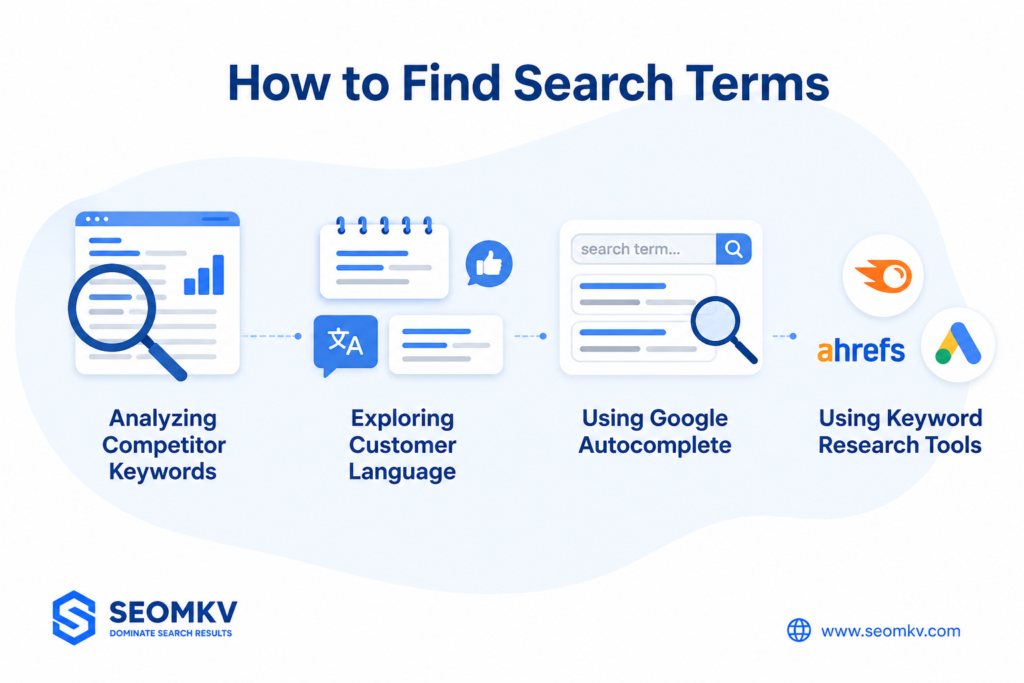
How to Find Search Terms
Finding the right search terms is key for creating content that clicks with your audience and improves online visibility.
Using Google Autocomplete
Finding the right keywords can feel tricky, but it doesn’t have to be. One simple way I’ve used is Google Autocomplete.

You know when you start typing something into Google, and it suggests ideas before you finish? That’s Autocomplete. It shows you what others are searching for. If I type “best running shoes,” it might finish it with “for kids” or “for flat feet.” These suggestions can tell us what people want to know.
At seomkv SEO, we’ve used this to help clients create better content. For example, a fitness blog we worked with used Autocomplete to find terms like “how to start running” or “running tips for beginners.” Those posts ended up ranking really well. It’s easy and really helpful.
Analyzing Competitor Keywords

Ever wonder which keywords your competitors rank for? It’s worth checking out. Sure, it shows how tough your niche might be, but it also reveals gaps—opportunities they missed. Find those overlooked keywords, the hidden gems.
By focusing there, you can carve out your own space and bring in visitors who actually need what you offer.
Exploring Customer Language

Ever wonder how your customers actually talk about their needs? Their reviews, feedback, even social posts—those are gold. The words they use? That’s your keyword jackpot. It’s not perfect, but it’s real. And when you use their language, your content clicks. Feels more natural, right? More like them.
Using Keyword Research Tools
Google provides several tools to help find the best search terms for your needs. These tools make it easier to understand what people are looking for online and how to reach them.
Google Ads

Google Ads is a powerful tool to uncover keywords and audience insights. Start by exploring these features:
- Search Terms Report: This shows you which keywords people are using to find your ads. It’s great for spotting trends and refining your keyword list.
- Search Terms Insights: Dive deeper into specific searches. Find out which terms perform best so you can adjust your campaigns for better results.
Google Keyword Planner

Google Keyword Planner helps you find new keyword ideas and shows how often people search for them. It also gives you insight into how competitive those keywords are, making it easier to pick the right ones.
Google Search Console

Google Search Console lets you see which search terms bring people to your site. It highlights your top-performing keywords and helps you identify areas to improve your website’s visibility.
Google Trends

Google Trends shows you what’s popular right now. It tracks search term popularity over time and compares keywords, so you can stay ahead of current trends in your niche.
Semrush Keyword Magic Tool

The Keyword Magic Tool by Semrush is powerful for in-depth keyword research. It helps you discover new keywords, organizes them into groups, and shows important data, like search volume and competition. This tool is perfect for finding the right opportunities and planning your content strategy effectively.
- Search volume: This shows how many people are searching for a specific keyword each month. It helps you understand which topics are popular and worth targeting.
- Keyword difficulty: This score tells you how hard it would be to rank for a keyword. Lower scores mean it’s easier to compete and get noticed.
- CPC: Cost per click tells you how much advertisers pay for each click on a keyword ad. It’s useful for planning budgets and spotting valuable keywords.
Ahrefs

Ahrefs is a tool that helps you understand how websites work and how to improve them. You can use it to find out which websites link to yours, which keywords bring people to your site, and how your website ranks on search engines visibility.
It also shows you what your competitors are doing online. This helps you find ways to stand out. Ahrefs is like a roadmap for improving your website and making it more visible to others.
How Search Intent Affects Search Terms
Sometimes, writing takes on different roles. It’s not always perfect, right? Each type of content serves a unique purpose. Let’s break it down – one step at a time.
- Informational: Ever feel overwhelmed by questions? That’s where informational writing comes in. It’s like a friend explaining things clearly and simply. No fluff, just answers you’re searching for.
- Commercial: Selling something doesn’t have to feel pushy. Commercial writing sparks interest without being over the top. It’s about connecting with people, showing them why something might actually help.
- Transactional: Straightforward, right? This is the action-oriented stuff. It’s the “click here” or “buy now” moments. No fancy words—just clear, simple steps to get things done.
- Navigational: Feeling lost? Navigational writing is like a map. It points you in the right direction, whether it’s a website or a physical space. You’ll know exactly where to go.
Measuring the Success of Your Search Term Strategy
Assessing your search term strategy is key for improving SEO efforts and maximizing content impact.
Key Metrics to Track
Metrics matter, so be sure to keep an eye on them. Organic traffic shows who’s finding you, but is it enough? Bounce rate? A reality check—are people sticking around or bailing fast? Then there’s keyword rankings. Great if you’re climbing, but what if you’re not? Then there’s conversion rates. Are visitors becoming customers? Together, these metrics sketch the bigger picture of your search term strategy’s success.
Using Google Analytics and Search Console

Not sure if your search terms are really doing their job? Tools like Google Analytics and Search Console can help. Analytics dives into user behavior—organic traffic, bounce rates, and top keywords. Pretty useful, right? Meanwhile, Search Console shows how Google views your site and flags issues. Sure, it’s not perfect, but pairing these tools can fine-tune your strategy and get those search terms pulling their weight.
Adjusting Strategy Based on Data
Adjusting your strategy is not always easy. Start by checking the metrics like Google Analytics, Search Console. Maybe keywords aren’t working, or your bounce rate’s climbing. Do you tweak content? Try new ideas? It’s trial and error, but staying flexible, learning from the data—that’s how you keep growing in this unpredictable digital world. You adapt. You improve.
Search Term Examples
Paid Advertising Search Terms Example
Paid advertising search terms help us reach the right people quickly. These are the words or phrases people type into search engines when they want something specific.
For example, if we’re running a campaign for a local pizza restaurant, a good search term might be “best pizza near me” or “late-night pizza delivery.” We focus on terms that match what users want, so our ads show up at just the right moment. By choosing these carefully, we get more clicks and better results.
At Visibility SEO, we know picking strong search terms can make all the difference.
Organic Search Terms Example
Organic search terms are just the words people type into search engines when they’re looking for information or products. For example, let’s say we’re working with a small bakery that sells cupcakes online.
A good organic search term might be “buy chocolate cupcakes” or “cheap cupcakes near me.” When people search for those words, we help the bakery show up higher in the search results.
At Visibility SEO, we make sure these terms match what people are actually searching for. That way, the bakery gets more visits to their website and, hopefully, more cupcake sales. It’s all about connecting the right words to the right people.
Turn Search Terms into Valuable Keywords
We know how important it is to get noticed online. That’s why we work hard to make sure businesses like yours show up when people search.
At Visibility SEO, we take search terms and turn them into powerful keywords that drive traffic to your site. For example, if someone searches for “best birthday cupcakes,” we make sure your bakery is one of the first places they see.
More clicks mean more sales. Ready to grow your business? Let’s make it happen together.
FAQs
What are examples of search terms?
A search term is the exact word or phrase typed into a search engine to find information. Examples vary by intent, ranging from broad, short-tail phrases (e.g., “running shoes”) to long, specific questions (e.g., “best coffee shop near me”).
What are search terms in research?
Search terms in research are the specific words and short phrases used to locate relevant literature in academic databases (like PubMed or Google Scholar). They consist of two main categories: keywords (natural language words from a title or abstract) and subject headings (standardized index tags).
What are SEO search terms?
SEO search terms (or keywords) are the specific words or phrases users type into search engines to find information, products, or services.
What’s the difference between search terms and keywords?
Search terms are the words people type into search engines when they’re looking for something—whether that’s answers, products, or services. Keywords, on the other hand, are the terms marketers use in their content to help it show up in search results.
Why do both matter? Search terms show how people actually search online. Keywords are picked to match those searches and boost visibility. To create great SEO strategies, you need to understand both.
Where do keyword tools get data about search terms?
Keyword tools get their data mostly from search engines like Google. They figure out which terms people search for a lot by looking at search activity and past queries. These tools also check search trends, how competitive terms are, and how many people are using them.
Some tools also use data from platforms that track what people do on websites. By connecting with search engines and getting data from other sources, they provide up-to-date keyword suggestions to help improve your SEO strategy.
How to rank your content for the right search terms?
SEO can feel overwhelming, right? So many rules, and honestly, it’s easy to miss a step. But here’s the thing: imperfection is okay. Let’s simplify it a bit:
- Match the user’s search intent: Think about this—what’s the user really looking for? Not just keywords, but their goal. Are they curious? Ready to buy? Your content should meet them right where they are.
- Include related search terms in your content: Don’t overthink it. Just weave in natural, related phrases as you write. Think of it as a conversation—how would you explain the topic to a friend?
- Target related long-tail search terms: These are gold. Why? Because they’re specific, and specific means easier to rank for. Focus on those niche questions or needs your audience might Google at 2 a.m.